
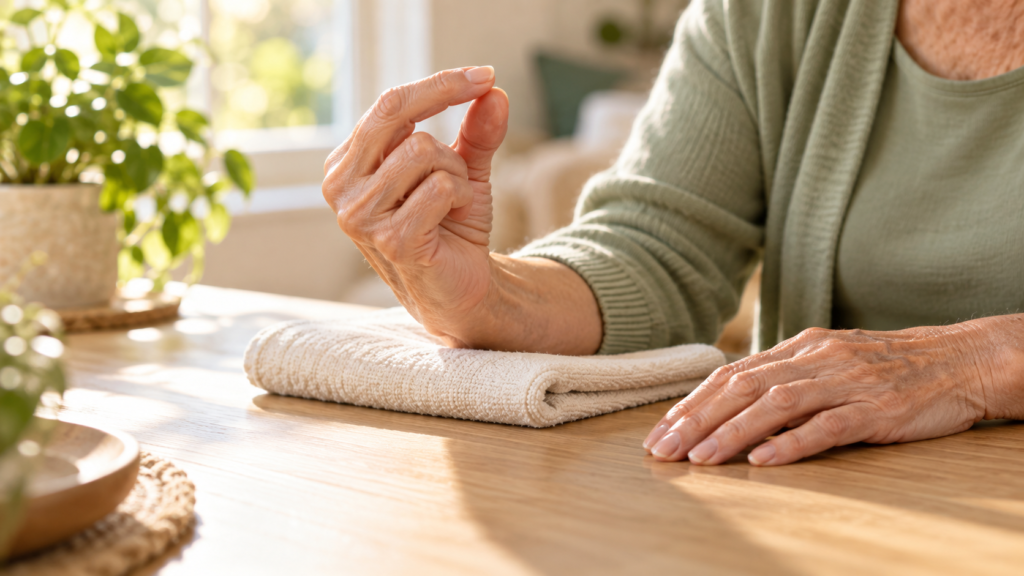
Hands rarely get a quiet day. They button shirts, open containers, type messages, prepare meals, carry bags, and help us connect with other people. When arthritis brings pain or stiffness to the fingers, thumbs, or wrists, even small tasks can begin to demand more effort.
The answer is not always to stop moving—and it is not to push through sharp pain. Gentle, well-chosen movement may help maintain flexibility and hand function. The most useful routine is one that matches the type of arthritis, the joints involved, current symptoms, and the activities a person wants to keep doing.
Why Gentle Movement Can Help
Arthritis can make a joint feel stiff, especially after rest. Slowly moving the fingers and wrists through a comfortable range may help prepare the hands for daily activity. Strengthening can also be useful for some people, but it should be introduced thoughtfully. Current osteoarthritis guidance strongly supports ongoing exercise while acknowledging that there is not one ideal hand routine or dosage for everyone.
A hand therapist or occupational therapist can evaluate motion, strength, swelling, joint alignment, sensation, and the tasks that are becoming difficult. That assessment matters because osteoarthritis, rheumatoid arthritis, tendon problems, nerve conditions, injury, and post-surgical restrictions may call for different approaches.
A Gentle Hand-Movement Sequence
Begin in a comfortable seated position with the forearm supported. Move slowly and stay within an easy range. A therapist may change or omit any movement based on the joints involved.
- Open and relaxed fist: Start with the fingers comfortably straight. Slowly bend them into a loose fist without squeezing, then open the hand again. Think smooth movement rather than force.
- Finger roll: With the wrist neutral, bend the middle and end joints of the fingers, then continue toward a comfortable fist. Reverse the sequence to straighten them. This explores motion across several finger joints.
- Thumb-to-fingertip touches: Touch the thumb lightly to the index fingertip, then the middle, ring, and little finger. Keep the touch soft rather than pinching hard.
- Finger spread and return: Rest the hand on a table if that is comfortable. Gently spread the fingers apart, then bring them back together. Avoid forcing a joint that feels unstable or sharply painful.
- Comfortable wrist motion: Support the forearm and move the wrist gently up and down within a pain-free range. Keep the fingers relaxed and make the motion small if the wrist is sensitive.
Start Small and Notice the Response
A short routine performed consistently is often more manageable than a long workout. Someone beginning on their own might try only three to five slow repetitions of each comfortable movement, then see how the hands respond. A clinician may recommend a different frequency or number of repetitions.
Discomfort is useful information. Stop if a movement causes sharp or escalating pain, new numbness, catching, or a feeling that the joint is giving way. The Arthritis Foundation’s practical “two-hour rule” suggests that if arthritis pain is worse two hours after exercise than it was beforehand, the session was probably too demanding. Reduce the range, resistance, or number of repetitions next time and discuss persistent symptoms with a professional.
What About Flare Days?
When the hands are unusually hot, swollen, or painful, it may be appropriate to pause strengthening and gripping exercises. Gentle range-of-motion movements may still feel helpful, but the goal on a flare day is not to test limits. A healthcare professional can help distinguish a typical flare from symptoms that need evaluation.
Some people find brief warmth helpful before movement. Thermal approaches are conditionally recommended for hand osteoarthritis, but heat is not right for every person—especially when sensation or circulation is impaired or a joint is acutely inflamed. Use only a comfortably warm temperature and follow individualized guidance.
Strengthening Comes After Comfortable Motion
Exercise putty, a soft ball, or resistance bands may be part of a hand-therapy plan, but harder squeezing is not automatically better. The Arthritis Foundation advises avoiding squeezing movements during an active hand flare. A therapist can select the right resistance and make sure the exercise supports a real-life goal rather than simply tiring painful joints.
Hand therapy may also include a custom or prefabricated support, joint-protection strategies, adaptive tools, and changes to how a task is performed. For example, using both hands, choosing a larger handle, or sliding an item across a counter may reduce strain while preserving independence.
When to Ask for Help
Seek medical guidance for new or rapidly worsening swelling, redness, warmth, weakness, numbness, joint deformity, significant injury, or pain that interrupts sleep or daily function. Sudden hand weakness—especially with facial drooping, speech difficulty, dizziness, or other neurologic symptoms—requires emergency evaluation.
At Restorative Solutions, occupational and hand therapy focus on the life behind the exercise: preparing food, managing fasteners, returning to a hobby, using a phone, or caring for family. An individualized plan can combine movement, protection, adaptation, and pacing so that the routine supports the things that matter most.
Educational Note
This article is for general education only. It is not a diagnosis, an individualized exercise prescription, or a substitute for medical care. Readers should consult a qualified healthcare professional for personal symptoms and follow current post-surgical or rehabilitation precautions.
References
• American College of Rheumatology/Arthritis Foundation. 2019 Guideline for the Management of Osteoarthritis of the Hand, Hip, and Knee. https://pmc.ncbi.nlm.nih.gov/articles/PMC11488261/ (accessed September 26, 2026).
• Arthritis Foundation. 9 Exercises to Help Hand Arthritis. https://www.arthritis.org/health-wellness/healthy-living/physical-activity/other-activities/9-exercises-to-help-hand-arthritis (accessed September 26, 2026).
• Arthritis Foundation. Working Out Through Pain. https://www.arthritis.org/health-wellness/healthy-living/physical-activity/success-strategies/working-out-through-pain (accessed September 26, 2026).
• Arthritis Foundation. Occupational Therapy for Arthritis. https://www.arthritis.org/health-wellness/treatment/complementary-therapies/physical-therapies/occupational-therapy-for-arthritis (accessed September 26, 2026).