
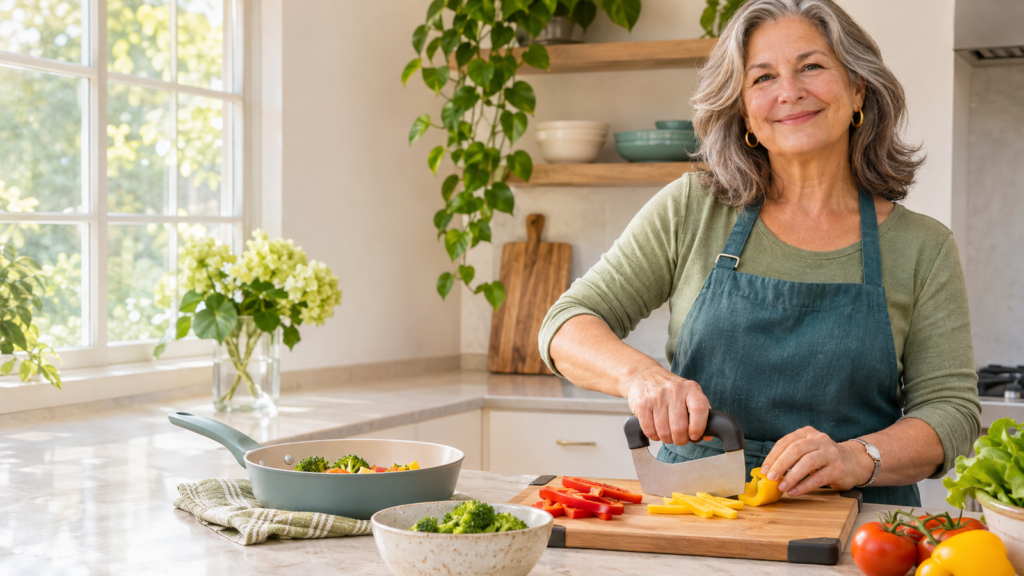
Cooking can be creative, comforting, and an important part of caring for yourself and others. It can also ask a lot of your hands, wrists, shoulders, back, and energy—especially when a recipe involves chopping, gripping, lifting, and cleaning all at once.
If joint pain, stiffness, weakness, or fatigue makes the kitchen feel harder than it used to, the answer is not always to stop cooking. Occupational therapy often looks at the fit between the person, the task, and the environment. A few changes to how the kitchen is arranged and how a task is completed may help you use less force, spread the work across your body, and save energy for the parts of the meal that matter most.
Joint Protection Is About Working Differently
Joint protection does not mean avoiding all movement. It means choosing movement patterns, tools, and routines that reduce unnecessary stress while supporting participation. Current arthritis guidance also emphasizes staying active: regular, joint-friendly physical activity can support pain management, function, mood, and quality of life.
In the kitchen, joint protection may mean using two hands instead of one, choosing a larger handle, sliding an item rather than lifting it, or splitting preparation into shorter sessions. These strategies are not a test of willpower. They are practical ways to make an everyday activity more sustainable.
Set Up the Task Before You Start
Place frequently used ingredients and tools between about waist and shoulder height when possible. This can reduce repeated bending, overhead reaching, and searching through crowded cabinets. Clear a stable work area, gather what you need, and bring a trash bowl or container close to your cutting board so scraps do not require extra trips.
Consider sitting on a supportive chair or sturdy stool for tasks that can be done safely at a table or counter. Keep your shoulders relaxed and bring the work toward you instead of leaning over it. A nonslip mat beneath a bowl or cutting board can stabilize the item so your hands do not have to grip as hard.
Spread the Load
Whenever practical, use both hands to carry a plate, mixing bowl, or pan. Keep heavier items close to your body. Cookware with two handles can distribute weight more evenly, and lightweight pots or smaller batches can reduce the load in the first place.
Sliding a heavy pot along a dry, clear counter may be easier than lifting it. Instead of carrying a full pot of water, place the pot where it will be used and transfer water with a smaller container. Safety comes first: avoid sliding hot items across an unstable surface, and ask for help when a task is beyond what feels controlled.
Reduce Tight Gripping and Twisting
Small, narrow handles usually require more gripping force. Utensils with wide, textured, or cushioned handles may be easier to control. A jar opener, electric can opener, food processor, kitchen shears, or ergonomic knife may reduce force or repetition. The best tool is not necessarily the most expensive one—it is the one that fits your hand, the task, and your safety needs.
Try using your palm or forearm for a push when appropriate rather than pinching with your fingertips. Keep the wrist in a comfortable, fairly straight position during gripping tasks. If an activity requires a long, unbroken hold, look for a way to secure the item, change hands, or pause before your grip becomes exhausted.
Pace the Whole Meal, Not Just One Step
Pacing works best when breaks happen before symptoms become overwhelming. Alternate heavier tasks with lighter ones: wash produce, sit to chop, pause while something cooks, and leave nonurgent cleanup for later. Preparing ingredients earlier in the day or choosing pre-cut or frozen produce can be a smart adaptation, not a shortcut to feel guilty about.
A one-pan recipe, smaller batch, or shared cooking plan can reduce the number of movements and dishes required. If you notice that one part of meal preparation consistently causes difficulty, change that one step first rather than redesigning the entire kitchen at once.
Let Symptoms Guide a Conversation
Pain is personal, and one strategy will not fit every diagnosis or every day. New swelling, redness, warmth, loss of strength, numbness, an injury, or pain that is severe, persistent, or changing deserves medical attention. Do not use general kitchen advice to push through symptoms that make a task unsafe.
An occupational therapist can observe the actual movements and demands involved in cooking, recommend task or environmental changes, help you compare adaptive tools, and address pacing, strength, range of motion, or splint needs when appropriate. Recommendations should be individualized, especially when a condition affects sensation, balance, healing, or joint stability.
Try One Small Kitchen Experiment
Choose one meal this week and notice where the most effort goes. Is it opening containers, standing, chopping, lifting, or cleanup? Try one change: sit for preparation, use two hands, widen a handle, slide a cool heavy item, or break the task into stages. Then notice whether the activity feels more controlled and leaves you with more energy afterward.
Restorative Solutions provides occupational therapy support focused on daily function, comfort, confidence, and participation. Contact our team to ask whether an individualized evaluation could help you make cooking—or another meaningful routine—work better for you.
Internal References for Review
- American Occupational Therapy Association (AOTA). “Musculoskeletal Conditions.” Describes occupational therapy support for engagement in occupations alongside interventions addressing muscles, bones, tendons, ligaments, joints, and connective tissues. https://www.aota.org/practice/clinical-topics/musculoskeletal-conditions (accessed November 15, 2026).
- Centers for Disease Control and Prevention (CDC). “Talking to Patients About Self-Management.” Updated June 10, 2026. Supports joint-friendly physical activity, self-management education, and protection from joint injury. https://www.cdc.gov/arthritis/hcp/self-management/index.html (accessed November 15, 2026).
- Fraenkel L, et al. “2022 American College of Rheumatology Guideline for Exercise, Rehabilitation, Diet, and Additional Integrative Interventions for Rheumatoid Arthritis.” Arthritis Care & Research. Describes comprehensive OT, joint protection, activity pacing, work simplification, fatigue management, and assistive devices. https://stacks.cdc.gov/view/cdc/151745 (accessed November 15, 2026).
- Arthritis Foundation. “Eat Well, Feel Better,” Meal Prep & Kitchen Tips. 2025. Recommends planning, accessible storage, sitting for tasks, wide-handled or electric tools, lightweight cookware, sliding instead of lifting, and staged preparation. https://www.arthritis.org/getmedia/4dce98db-853f-4522-a12c-4995736b9994/EatingWellWithArthritis_Ebook_FINAL_AR_25-3000-0553_121725.pdf (accessed November 15, 2026).
- Kent Community Health NHS Foundation Trust. “Joint Protection.” Published September 10, 2026. Reviews respecting pain, taking breaks, using larger joints, spreading loads, sliding heavy objects, and using assistive devices. https://www.kentcht.nhs.uk/leaflet/joint-protection/ (accessed November 15, 2026).