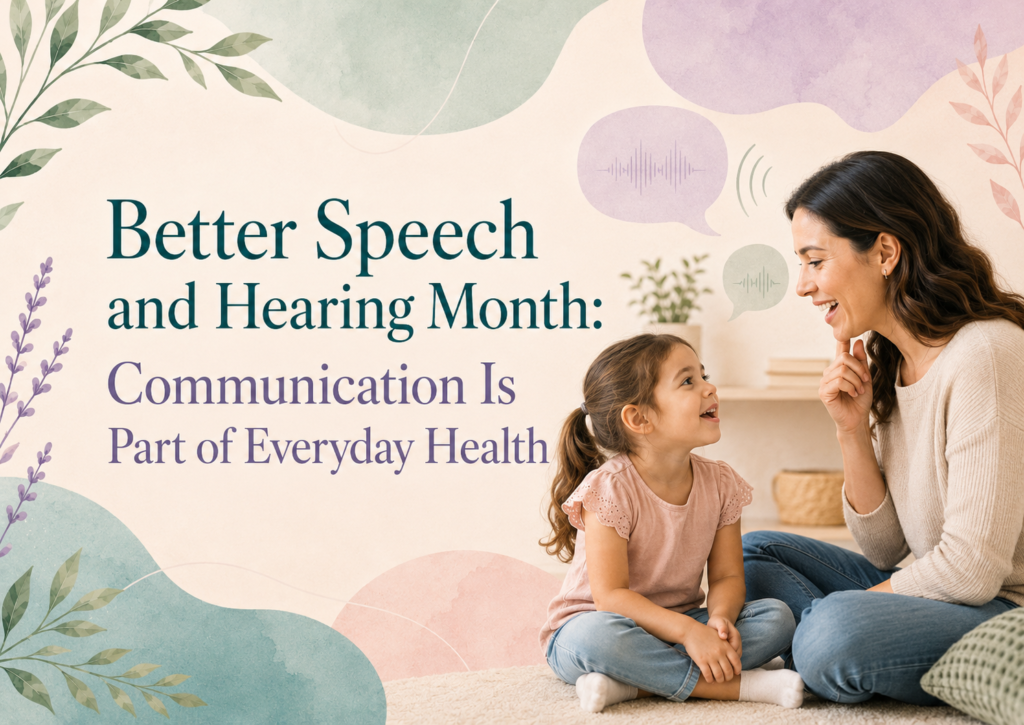
May has long been recognized as Better Speech and Hearing Month and is now also known as National Speech-Language-Hearing Month. It is a chance to notice how hearing, speech, language, and communication affect daily life, safety, relationships, learning, and independence.
May has long been known as Better Speech and Hearing Month. Beginning in 2024, the observance has also been recognized as National Speech-Language-Hearing Month. Whatever name people use, the purpose is the same: to raise awareness about communication disorders and encourage people to seek support when hearing, speech, language, voice, or swallowing concerns affect daily life.
Communication is not a small part of life. It is how we connect with family, follow instructions, participate at school or work, ask for help, make decisions, stay safe, and enjoy relationships. When communication becomes harder, the effects can ripple into confidence, independence, behavior, learning, social connection, and emotional well-being.
At Restorative Solutions, we provide occupational therapy, not speech-language therapy or audiology. But communication still matters deeply in OT because it affects how people participate in the activities that give life structure and meaning.
Communication Challenges Can Look Different for Everyone
Communication concerns are not always obvious. Some people clearly struggle to hear or speak. Others may seem quiet, frustrated, distracted, overwhelmed, or withdrawn. Children may avoid certain tasks, have difficulty following directions, or become upset during transitions. Adults may feel exhausted after meetings, miss parts of conversations, or avoid noisy environments.
Possible signs that someone may benefit from a hearing, speech, or language evaluation include:
- Frequently asking people to repeat themselves
- Turning up the TV or phone volume
- Difficulty following conversations in groups or noisy places
- Speech that is hard for others to understand
- Trouble finding words or organizing thoughts
- Difficulty following directions
- Voice changes that do not improve
- Frustration during school, work, or social tasks
- Swallowing concerns, coughing during meals, or avoiding certain textures
These signs do not mean something is “wrong” with the person. They mean support may be helpful.
Why Early Support Matters
Communication difficulties can affect more than conversation. For children, hearing and language challenges may influence learning, reading, social participation, handwriting assignments, classroom routines, emotional regulation, and confidence. For adults, communication changes can affect work performance, safety, caregiving, relationships, medical appointments, and community participation.
Early support can make a meaningful difference. Audiologists can evaluate hearing and balance-related concerns. Speech-language pathologists can evaluate and treat speech, language, voice, cognitive-communication, social communication, and swallowing disorders. Occupational therapists can collaborate by supporting the daily routines, environments, sensory needs, motor skills, attention, and self-care tasks that communication is part of.
The right team depends on the person and the concern.
How OT and Communication Overlap
Occupational therapy looks at how a person functions in daily life. Communication is woven through many of those daily activities.
For children and teens, OT may support:
- Attention and executive functioning for following directions
- Sensory processing in noisy or busy environments
- Fine motor skills for writing and school participation
- Visual-motor skills for reading, copying, and classroom tasks
- Self-regulation strategies that make communication easier
- Daily routines that reduce frustration and improve independence
For adults and seniors, OT may support:
- Adapting routines after neurological changes
- Improving safety and independence at home
- Supporting memory, attention, and task organization
- Modifying environments to reduce overload
- Helping caregivers create clearer routines and cues
- Building strategies for meaningful participation in daily life
When speech, language, or hearing concerns are present, OT does not replace a speech-language pathologist or audiologist. Instead, OT can be part of a coordinated approach that helps the person use their strengths in real-world situations.
Hearing, Balance, and Safety
Hearing health can also affect safety. If someone cannot hear alarms, approaching traffic, instructions, or a person calling from another room, daily routines may become riskier. Hearing changes can also contribute to social isolation because conversations require more effort.
For older adults, hearing concerns may occur alongside balance changes, fall risk, vision changes, pain, or memory concerns. A whole-person plan may include hearing evaluation, home safety strategies, balance support, environmental modifications, and caregiver education.
Small changes can help, such as reducing background noise, facing the person when speaking, improving lighting, writing down important information, using visual schedules, and making sure hearing devices are working properly when prescribed.
Practical Ways Families Can Support Communication
If someone in your family is having difficulty communicating, try these supportive habits:
- Get the person’s attention before speaking.
- Face them so they can see your facial expressions.
- Reduce background noise when possible.
- Use short, clear sentences for complex instructions.
- Give extra time to respond.
- Avoid finishing every sentence for them unless they ask for help.
- Write down important details.
- Watch for frustration, fatigue, or sensory overload.
- Ask what helps instead of assuming.
These strategies are simple, but they can reduce stress and improve participation.
When to Ask for Help
Consider asking a healthcare provider about a referral if communication, hearing, swallowing, attention, or daily participation concerns are affecting school, work, safety, relationships, or independence. Children do not need to “grow out of it” before being supported. Adults do not need to wait until symptoms are severe.
Support is not about labeling someone. It is about giving them tools to participate more fully.
Restorative Solutions Can Help
Restorative Solutions supports children, adults, and seniors through occupational therapy services that address daily function, sensory processing, fine and gross motor skills, executive functioning, neurological conditions, balance, aging in place, and caregiver education. When communication concerns are part of the picture, we can help identify how they affect daily life and collaborate with the appropriate professionals.
This May, Better Speech and Hearing Month is a reminder to listen closely, communicate with patience, and seek support when communication begins to interfere with life.
Sources
- American Speech-Language-Hearing Association: National Speech-Language-Hearing Month
- ASHA: New Name Announced for Better Hearing and Speech Month
- National Institute on Deafness and Other Communication Disorders: May is Better Hearing and Speech Month
- National Institute on Deafness and Other Communication Disorders: Statistics About Hearing, Balance, Ear Infections, and Deafness